Regenerative Agriculture Takes Center Stage at Danforth Center Conversations Event
Can farmers feed a growing world and restore the land at the same time? That question drove the Danforth Center's latest Conversations event on Thursday, October 29. A farmer, a finance strategist, and a scientist took the stage to discuss what it really takes to make regenerative agriculture work, both in the field and on the balance sheet.
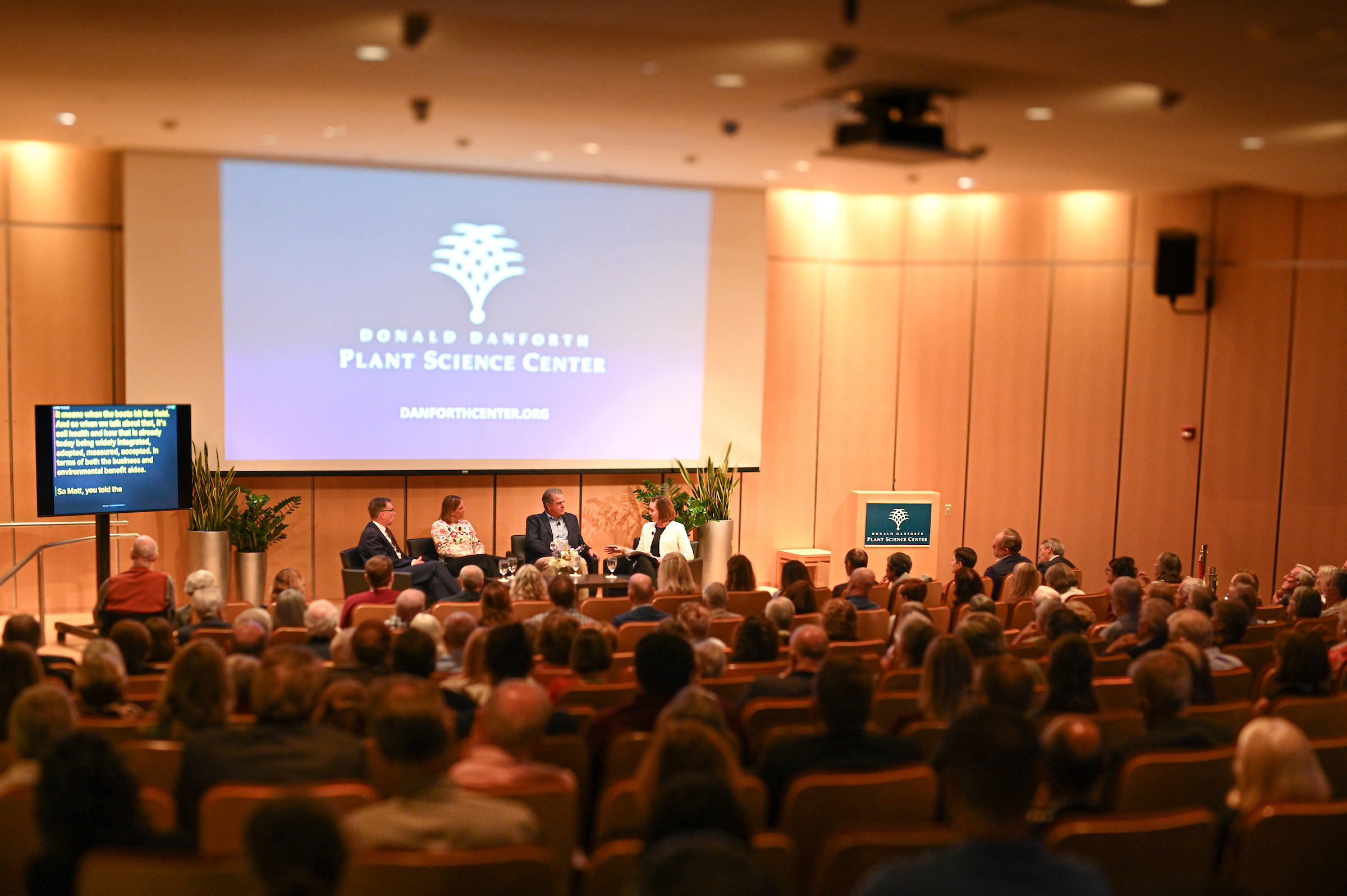
Moderated by Farm Journal's Margy Eckelkamp, the panel brought together Oklahoma farmer Matt Moreland, Rabobank global grains and oilseeds strategist Stephen Nicholson, and Dr. Allison Miller, the Danforth Center's vice president of research.

Moreland began farming in 1988 on 400 acres of his grandmother's land, tilling the soil with a heavy plow. Today he farms 21,000 acres across Oklahoma and Kansas and refrains from tilling, plants cover crops, and grazes cattle. All of those practices help keep carbon and nutrients in the soil, lowering fertilizer use, and helping to protect the land from erosion.
The change didn't happen overnight. He started testing no-till on a few acres in 1996, and he had to win over his grandmother, who dismissed it as “trash farming,” Moreland recalled.
The growth in Moreland’s harvests convinced even his grandmother. “There's no better data for me,” Moreland said. The shift to regenerative agriculture also helped bring his three sons back to the farm, which now employs 22 people.
Miller explained the science behind those results: plant roots are what rebuild soil. They create pores where water flows and microbes live. “The science is very clear on this,” she said. “Those cover crops and other types of year-round plants on the field, roots in the ground, are the engine of this regeneration.”
The panelists were candid about the barriers to scaling regenerative agriculture. Nicholson noted that programs paying farmers for regenerative practices remain fragmented. He added that fair lending laws prevent banks from offering lower interest rates as an incentive. Payoff also takes time. Lower fertilizer costs often show up first, but real returns may not come until year four or five.
Miller described how the Danforth Center is working to close those gaps. Its scientists are breeding corn that thrives in untilled fields, and developing cover crops that fix nitrogen to feed cash crops, or cover crops that can themselves be harvested for income. They are also improving the yields of perennial crops with deep, soil-building roots. “These are new goals for plant breeding,” she said, “to develop crops that are maximally productive and profitable under regenerative practices.”
The science is very clear on this: cover crops and other types of year-round plants on the field, roots in the ground, are the engine of regeneration of the soil.
Dr. Allison Miller
For farmers weighing the switch, Moreland's advice was simple: “Change is small and incremental, but you must start today.”
Danforth Center President Giles Oldroyd closed the evening by calling regenerative agriculture “the farming of the future.” He said the real tipping point will come when farmers can point to their neighbors and say, “Why are you doing it that way? You're losing money, and I'm making the money.”
Media Sponsor

For information on sponsoring Conversations, email Lee'at Bachar, Director of Corporate and Foundation Giving, or call 314.587.1210.