New Scientists Sprout as the First Pivot to Plants Fellows Enter the Workforce
As 2025 comes to a close, the first cohort of Pivot to Plants Fellows—Kevin Hava, Sunita Lama, Jesse Laseter, Tess Rogers, and Eliza Seigel—will complete their journey in this pioneering new program, closing out a season of growth, learning, and bold career pivots.
About Pivot to Plants
The Pivot to Plants Fellows Program, supported by the National Science Foundation (award 2347188), is a one-year, paid training program for people who are interested in pivoting to a career in plant science, imaging, data science, or related STEM fields, but have limited research experience. It invites adults with an associate’s degree or higher to develop skills in emerging technologies, providing a path to a new career trajectory in the sciences.
The program’s ultimate goal is to give bright, hardworking, passionate people the tools they need to successfully re-enter the workforce as scientists. In this inaugural year, the program has been a great success; with more than a month still remaining, three of the five fellows have already accepted job offers in the St. Louis plant science community. Jesse Laseter has gone on to work for RNAissance Ag. Tess Rogers has accepted a job at Bayer Crop Science and will start her work there soon. And Kevin Hava will join the Danforth Center’s Education Research and Outreach Lab when the fellowship officially concludes.
Earlier this month, Eliza, Sunita, Kevin, and Tess gathered in the Langenberg Theater to showcase their research as their projects wind down. Each of the fellows gave a presentation followed by Q&A, and the community celebrated them afterward at a congratulatory reception. Get to know a little bit more about them and their research below!
Eliza Seigel
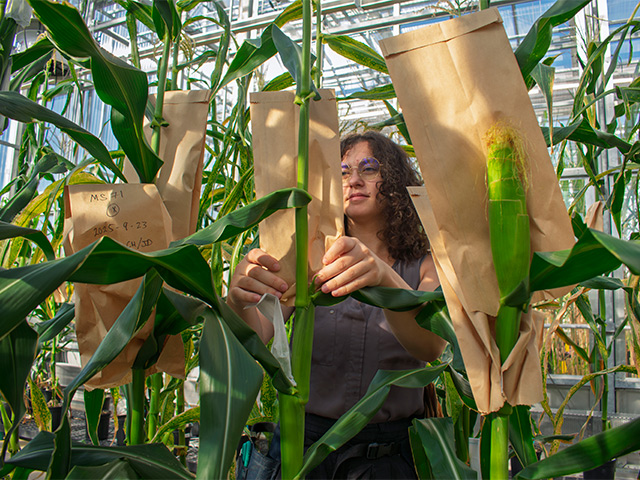
Eliza Seigel didn’t discover her passion for biology until later in her academic journey. Since her college experience was upended by the COVID-19 pandemic, hands-on, in-person experiences were limited. But when students were allowed back on campus after the COVID-19 pandemic, she started volunteering at her college’s greenhouse and fell in love with plants and biodiversity. Determined to gain more hands-on experience, she pursued fieldwork with AmeriCorps and the Chicago Botanic Garden, but she wanted to gain research experience as well. That’s where the Pivot to Plants program came in.
Eliza worked in the Fahlgren Lab, where her research focused on assessing maize kernel germination using x-ray imaging. Time spent in the greenhouses was familiar territory for Eliza, but the work in data science was a whole different side of plant science that she got to dive into. She became proficient at coding in PlantCV, and her research also exposed her to plant breeding, phenotyping, genetics, bioimaging, and more. Eliza's favorite part of the program has been learning about all the different fields of research within plant biology.
Sunita Lama
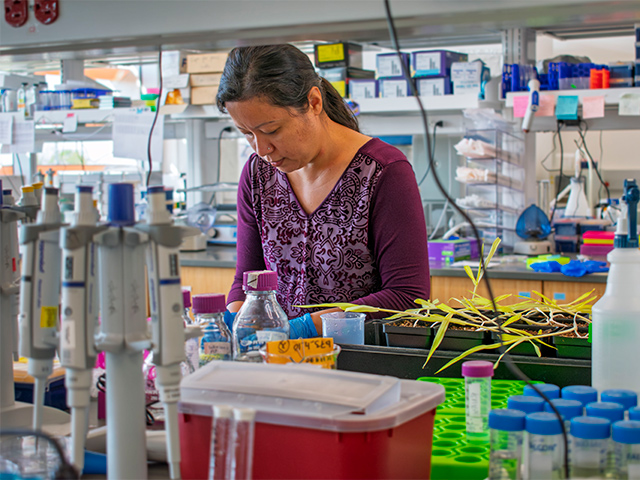
Sunita Lama’s background is in medical microbiology. Her love of gardening drew her to the Pivot to Plants program, where she knew she would have the opportunity to gain hands-on research after taking a break in her career. Her favorite part of the training was attending the weekly seminars and workshops, which helped her stay updated with current research and developments in plant science. Her long-term goal is to work as a research scientist in plant science, molecular biology, or microbiology.
Sunita spent her time as a fellow in the Gehan Lab, where she worked to develop a system for testing maize protoplasts, which are plant cells with their walls removed. This research contributes to the study of stress resistance in plants, which can help scientists understand how to improve crops for the future. To do this, she optimized a protocol for maize protoplast isolation, designed and conducted heat stress and metabolite treatment experiments on protoplasts, then analyzed image data and performed statistical analyses. She also assisted with large phenotyping and tissue collection experiments, learned molecular techniques such as DNA extraction, PCR and more.
Kevin Hava

Kevin Hava spent a decade teaching high school science before transitioning to a new career path. Prior to becoming a Pivot to Plants Fellow, he worked in ecological restoration at Forest Park and as a technician at the Danforth Center Field Research Site in St. Charles. But he didn’t have research experience and wanted the opportunity to build new skills that complement his background in conservation and education.
Kevin spent his time as a fellow in the Czymmek Lab. He focused on optimizing protocols for hybridization chain reaction and super-resolution imaging of phasiRNA biogenesis in maize anthers, the organ where pollen develops, which is critical for crop yields. He developed skills in bioimaging, dissection, microscopy, image analysis, and much more.
Tess Rogers
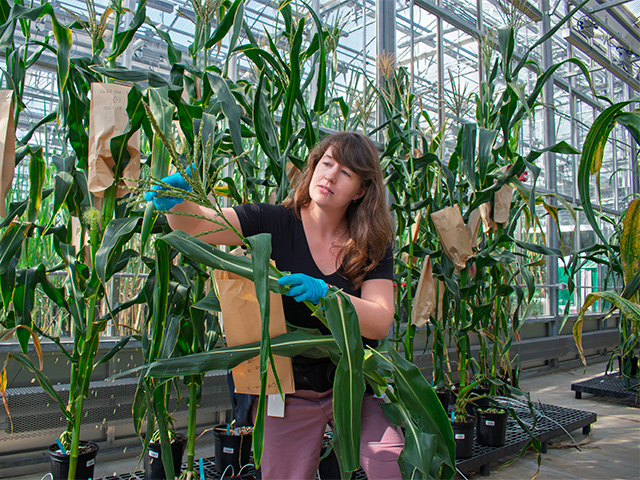
Before becoming a Pivot to Plants Fellow, Tess worked at a raptor rehabilitation center, where she had a wide range of responsibilities ranging from environmental education to behavioral training to field studies. She loved her work but was interested in research, and her love for nature inspired her to pursue research with real-world environmental applications.
She spent her time in the Murphy Lab, where she focused on studying how maize plants recover after experiencing heat stress early in their life. She became proficient in maize pollination and gained experience with PlantCV, phenotyping, statistical analysis, and more. Tess said she appreciated how many different areas of research the Pivot to Plants program helped expose her to on a weekly basis, and that even basic questions were always accepted with enthusiasm and encouragement. She is looking forward to seeing the skills she learned at the Danforth Center translate to the industrial scale in her upcoming position at Bayer Crop Science.
What’s Next?
In January 2026, we will welcome the next cohort of Pivot to Plants Fellows to the Danforth Center. And as the 2025 Pivot to Plants Fellows Program nears its end, this talented group of scientists is well-poised to take their next steps.
“The overwhelming support of the Danforth Center community was instrumental to reaching this stage,” said Fellow Tess Rogers. “I am grateful for the chance to show them exactly what that support has enabled us to achieve.”
We are grateful to have had such a brilliant and passionate group as our inaugural cohort, and we can’t wait to see what they do next.