BioBash Turns 15: Early-Career Scientists Explore How Research Becomes Real-World Impact
On Thursday, October 22, scientists, students, and job seekers from across St. Louis filled the Donald Danforth Plant Science Center for BioBash 2026, the Center’s 15th annual career networking event and job fair. BioBash is organized by the Center’s Committee for Scientific Training and Mentoring (CSTM), which represents graduate students, postdoctoral fellows, and technical staff.
BioBash provides an opportunity for early-career scientists throughout the community to learn how they can take their passion for science and translate it into a career. This year’s theme was "Impact of Science: Growing Toward a Sustainable Future." The day included three career panels, hands-on workshops, a networking lunch, and a career fair with agtech and biotech employers from around the region.
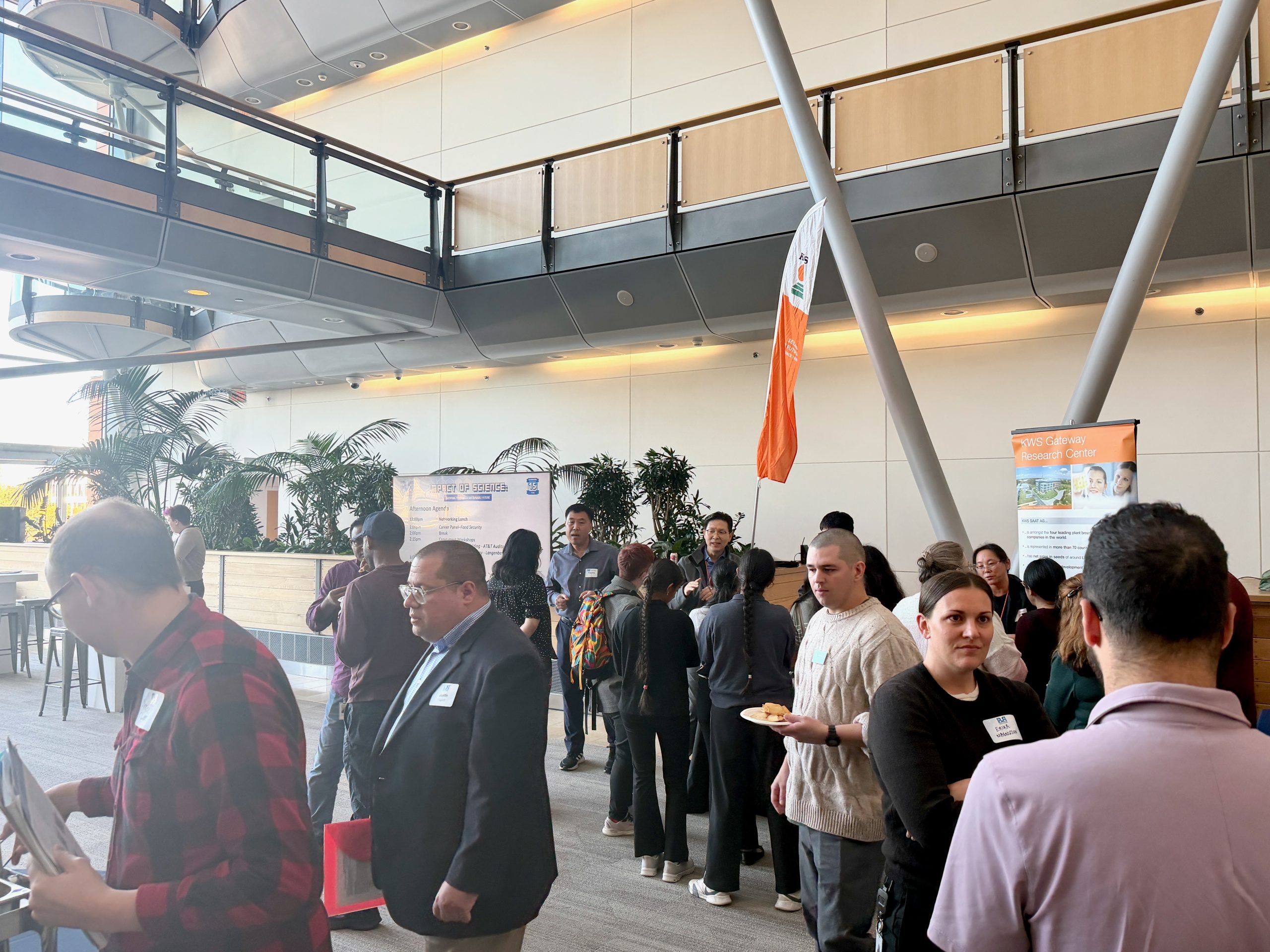
Attendees network and explore career opportunities in the life sciences during the event.
“We wanted to take the pillars of research here at the Danforth Center—sustainability, food security, and innovation—and highlight the challenges and opportunities within these domains so research can translate into real-world impact,” said Max Braud, senior research associate in the Eveland lab and CSTM co-chair.
Panelists came from industry, nonprofits, and the Center. Ryan Swanson, a University of Missouri graduate student in the Slotkin Lab, moderated the Sustainability panel with Chani Sorkin of Seed St. Louis, Tony Neumann of New Leaf Symbiotics, and Kiona Elliott of Bayer. Marcus Griffiths, research scientist in the Nusinow Lab, moderated the Food Security panel with Amy Funk and Nigel Taylor of the Danforth Center, Jakob Nalley of Pluton Biosciences, and Dean Gunderson of Seed St. Louis. Brooke Diehl, a University of Missouri graduate student in the Slotkin Lab, moderated the Innovation panel with Adam Saffer of CTC Genomics, Charles Armstrong of the St. Louis Academy of Science, Stephanie Gamez of Agragene, and Katie Murphy of the Danforth Center.
Meet People Where They Are
During the panels, a few themes emerged. One message came up again and again: a solution only makes a difference if it reaches the people it is meant to help.
“I didn’t grow up on a farm. I’m in the lab most of the time,” said Tony Neumann, director of molecular biology at New Leaf Symbiotics, on the sustainability panel, explaining why it is so important for ag innovators to understand farmers. “It can be easy to think of solutions to problems that maybe are not real for the people you’re actually trying to solve them for.”
Katie Murphy, director of the Danforth Center’s Phenotyping Facility, echoed this point during the innovation panel. Murphy and Noah Fahlgren, the Center’s data strategy director, interviewed about 70 peers about their work and bottlenecks, helping them build a tool that truly met people's needs. The National Science Foundation’s I-Corps program supported Murphy and Fahlgren in this work. (Today, PlantCV is making possible a new flood of research.)
Chani Sorkin, director of community projects at Seed St. Louis, highlighted the value of community knowledge. “You can go out and get a PhD in agriculture, and you totally should,” she said. “But who knows the best garlic to grow in your yard? Your neighbor.”
Seeing Is Believing
On the food security panel, Nigel Taylor, vice president of impact at the Danforth Center, described developing virus-resistant cassava for farmers in East Africa. “If the farmer has to do anything significantly different than they’ve done before, it’s very unlikely to be adopted,” he said. But when farmers actually see the healthy roots of virus-resistant cassava for themselves, he added, their only question is when they can get their hands on the new variety. “Seeing is believing. Tasting is believing as well.”
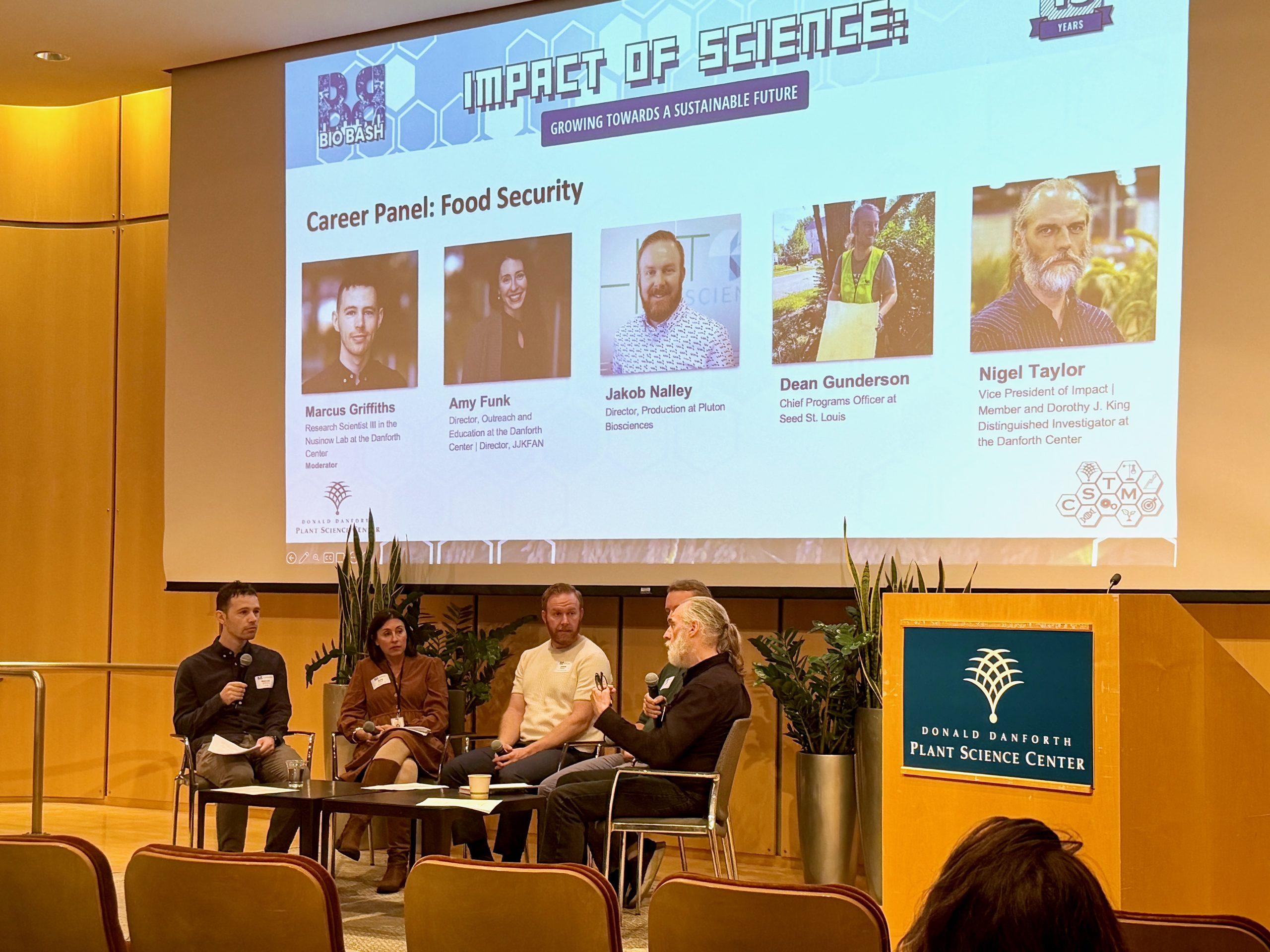
Panelists discuss careers in food security during the 15th annual BioBash at the Danforth Center.
Kiona Elliott, senior process and compliance manager at Bayer, echoed the high stakes for farmers during the sustainability panel: “For a farmer, in their lifetime, they have 30 chances. Every field season is a single shot.”
Finding a Path
Attendees came at different career stages, and from a variety of backgrounds. Jeaulayna Johnson-Torrence, a sophomore majoring in biomedical engineering at Washington University in St. Louis, came to see how professionals had turned their degrees into careers. “I always thought that if I took a gap year, I’d be behind,” she said. “But it’s actually very normal to take a gap year, situate yourself, figure out what you want to do.”
Jenna Doman, a manufacturing professional who volunteers with Seed St. Louis, grew up in a small Missouri farming town and is looking for her next role in agricultural science. “I’m looking for something where I feel like the work I’m doing is working toward something bigger, something applicable to the world at large,” she said.
Tejas Wagh recently moved to St. Louis after earning a master’s in machine learning engineering from Drexel University. He found more overlap with his field than he expected: “I got to talk with many people who have image processing or machine learning applications in their research.”
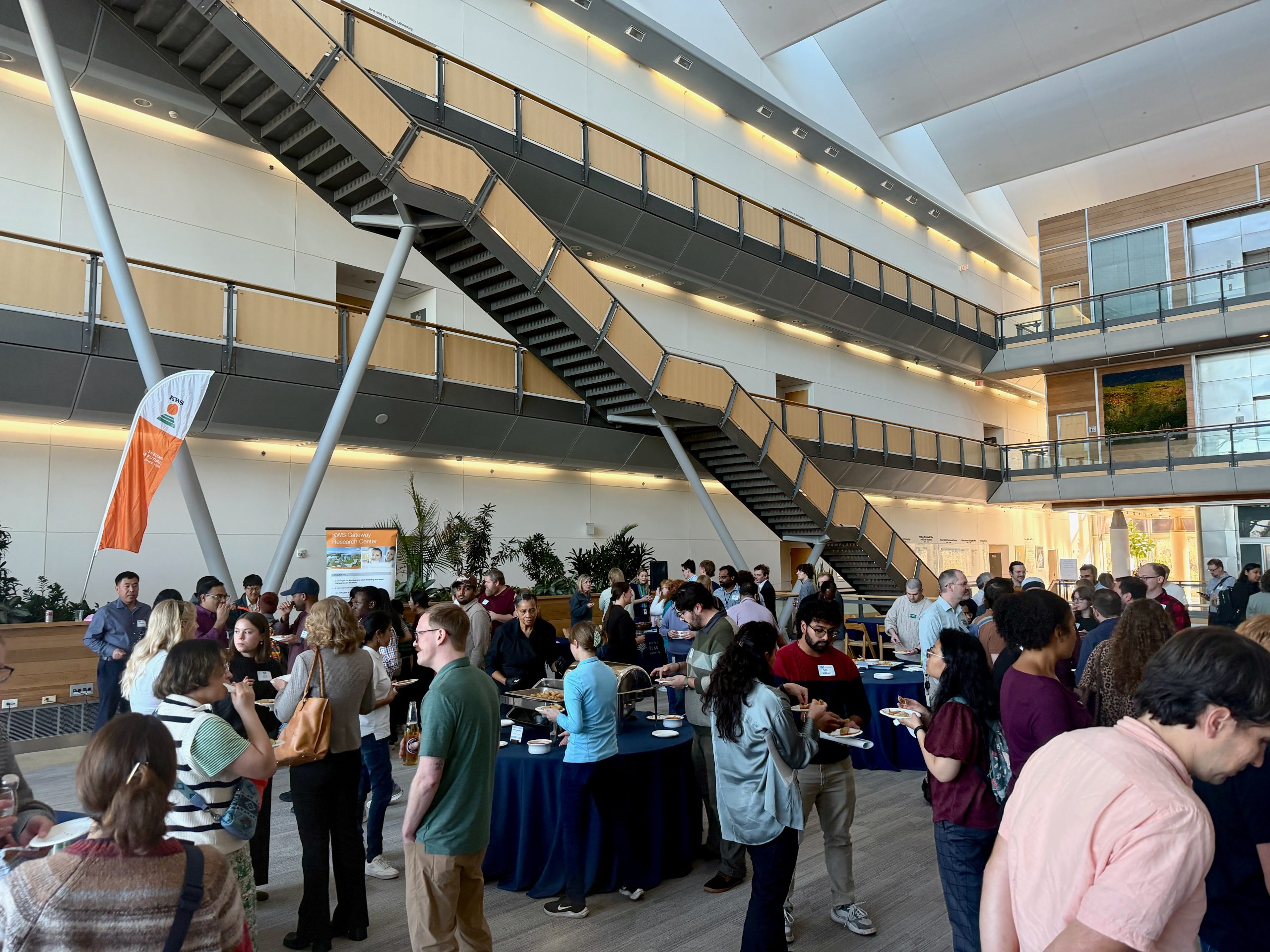
BioBash attendees connect with fellow scientists, students, and job seekers.
Speakers at the innovation panel shared career advice. They urged job seekers to network and connect with people at the companies they’re applying to in order stand out, and noted that for some hirers, a strong cover letter makes a difference. Murphy highlighted the Center’s Pivot to Plants Fellows Program, a paid, one-year fellowship for people from other backgrounds who want to move into plant science or data science—and noted that fellowship applications will open next fall.
Thank You
The Danforth Center thanks the sponsors of BioBash 2026: Silver sponsor KWS and Bronze sponsors Covercress and Sensient Food Colors. Their support helps connect early-career scientists in St. Louis with the companies and organizations building the region’s plant science workforce.
This year’s CSTM co-chairs were Matt Adams and Sam Shinkle, horticulturists in the Plant Growth Facility; Max Braud, senior research associate in the Eveland Lab; and Abigail Bryson, PhD, postdoctoral associate in the Slotkin Lab.