Generational Vision: Keith and Howard Duncan
Hidden away in the basement of the Danforth Center rests one of the most cutting-edge X-ray imaging instruments in the world. And a few feet away, on a nearby desk, sits a black and brass microscope from the early 1900s. It belongs to Research Scientist Keith Duncan, the Danforth Center’s Director of X-Ray Imaging. But it first belonged to an esteemed medical researcher: Keith Duncan’s father, Howard. In their own way, these two pioneering scientists have changed how we see our natural world. And together, they both are a critical part of the Danforth Center’s work.
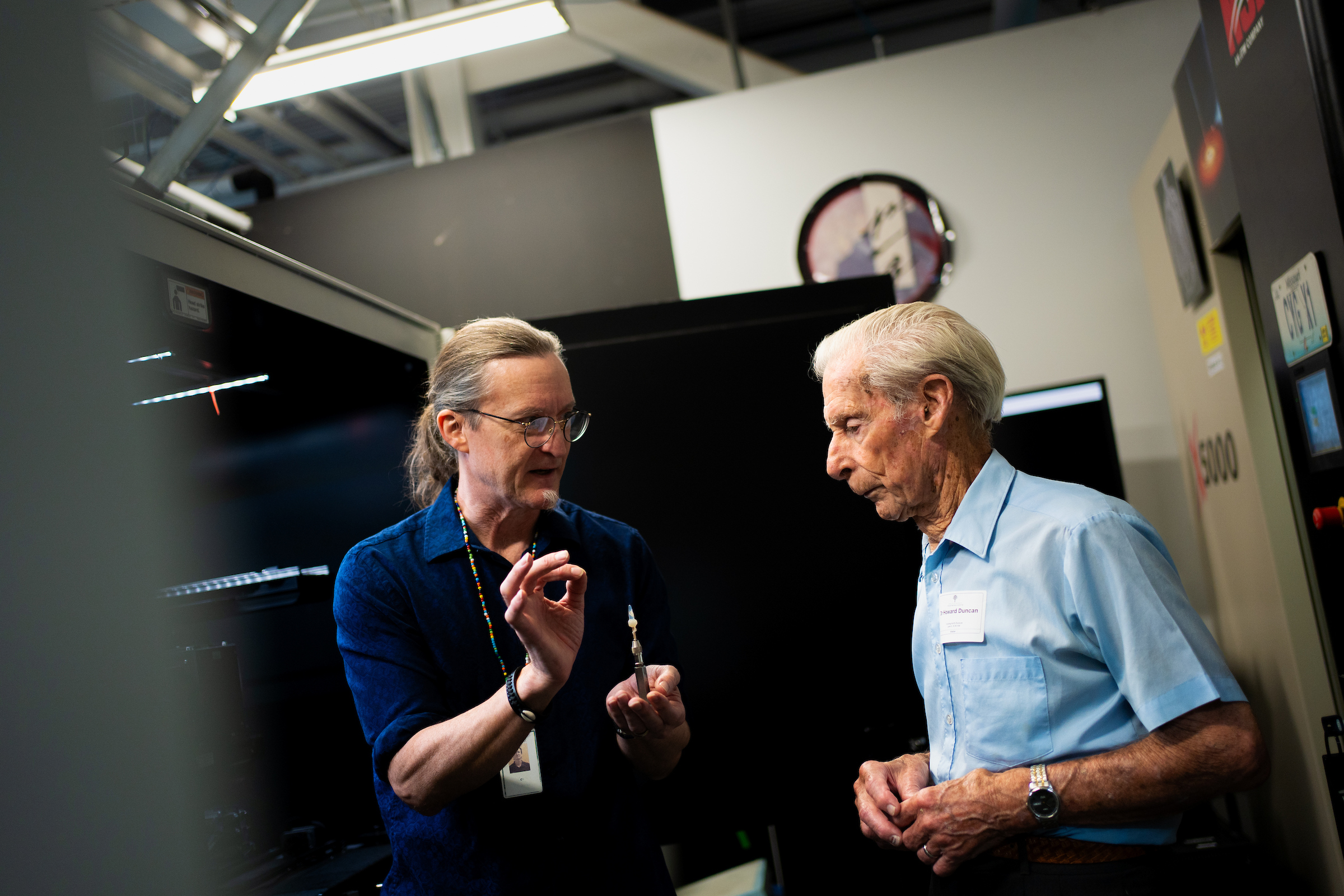
Keith Duncan showing his father Howard an X-ray microscope, which produces high resolution, 3D images of intact, delicate plant samples. This allows our scientists to study plant and microbe interactions right where they’re happening, and much more.
A New Lens
Once upon a time, people didn’t know much about bones. “It was thought to be like concrete,” says Dr. Howard Duncan. “Once you've made it, it stays there. Well, it's not.” Born and educated in Australia, Howard’s illustrious career in medical research spanned decades, continents, and prestigious institutions. Driven by his visionary belief that bones were living organs, he moved to Detroit in the 1960s to join a team that developed groundbreaking microscopy methods, proving his theories and providing the bedrock for much of what we now know about rheumatoid and osteoarthritis.
Back at home, Howard led by example to foster a similar curiosity about the world in his children. And something young Keith was particularly curious about was the old microscope in his dad’s office.
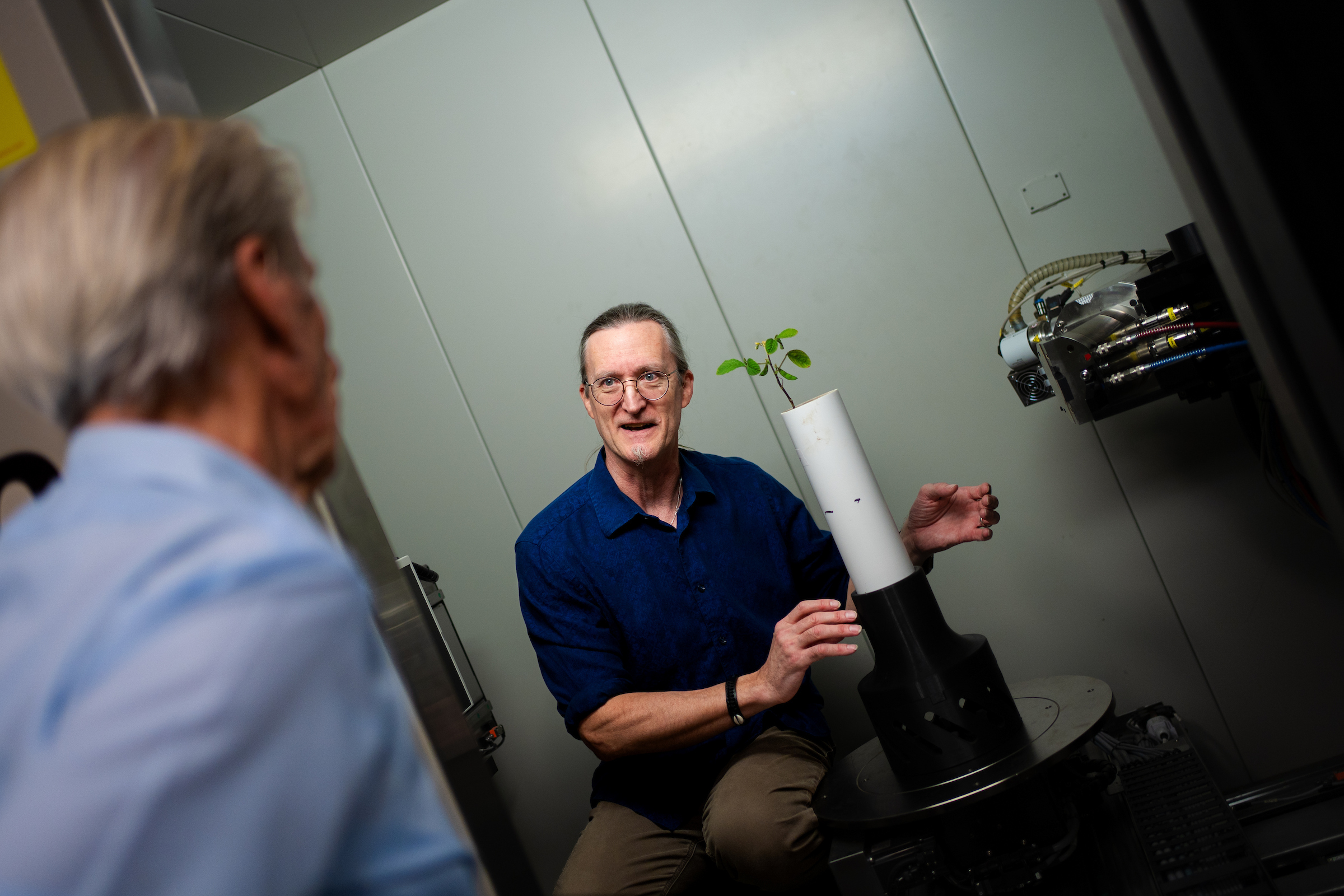
Keith showing his father the Danforth Center’s large-format X-ray tomography (XRT) instrument. While other imaging methods require plant samples to be cut up and destroyed, this instrument allows living, intact plants to be studied in 3D. The Danforth Center is one of the few plant science research institutes in the world that has one.
Changing Focus
Throughout his upbringing, Keith gravitated toward the microscope, and his love of seeing the hidden world was the catalyst for his own scientific career. He wound up working in a microscopy and imaging lab at DuPont in Delaware. But after 25 years, in the wake of mass layoffs, Keith was left without a clear path forward.
So he and his wife Ashlyn took a chance: they moved to St. Louis due to the region’s agtech ecosystem, and more specifically, to be near the Danforth Center. When he learned the Center was seeking someone to run an X-ray instrument that allows living, intact plants to be explored in 3D—something no other plant science facility had at the time—Keith applied “in about eight seconds flat." That was ten years ago, and what began as a leap of faith led him to his current role. He wouldn’t change a thing. “Having the opportunity to be a world leader in developing and pushing this boundary of X-ray imaging and plant biology, I don't know that I could have written a script that was more rewarding than that.”
At the Danforth Center, I can actually make substantial contributions to the condition of the world by doing my research. And that is a profound position, a profound opportunity, and a profound responsibility.
Keith Duncan Director of X-ray Imaging, Donald Danforth Plant Science Center
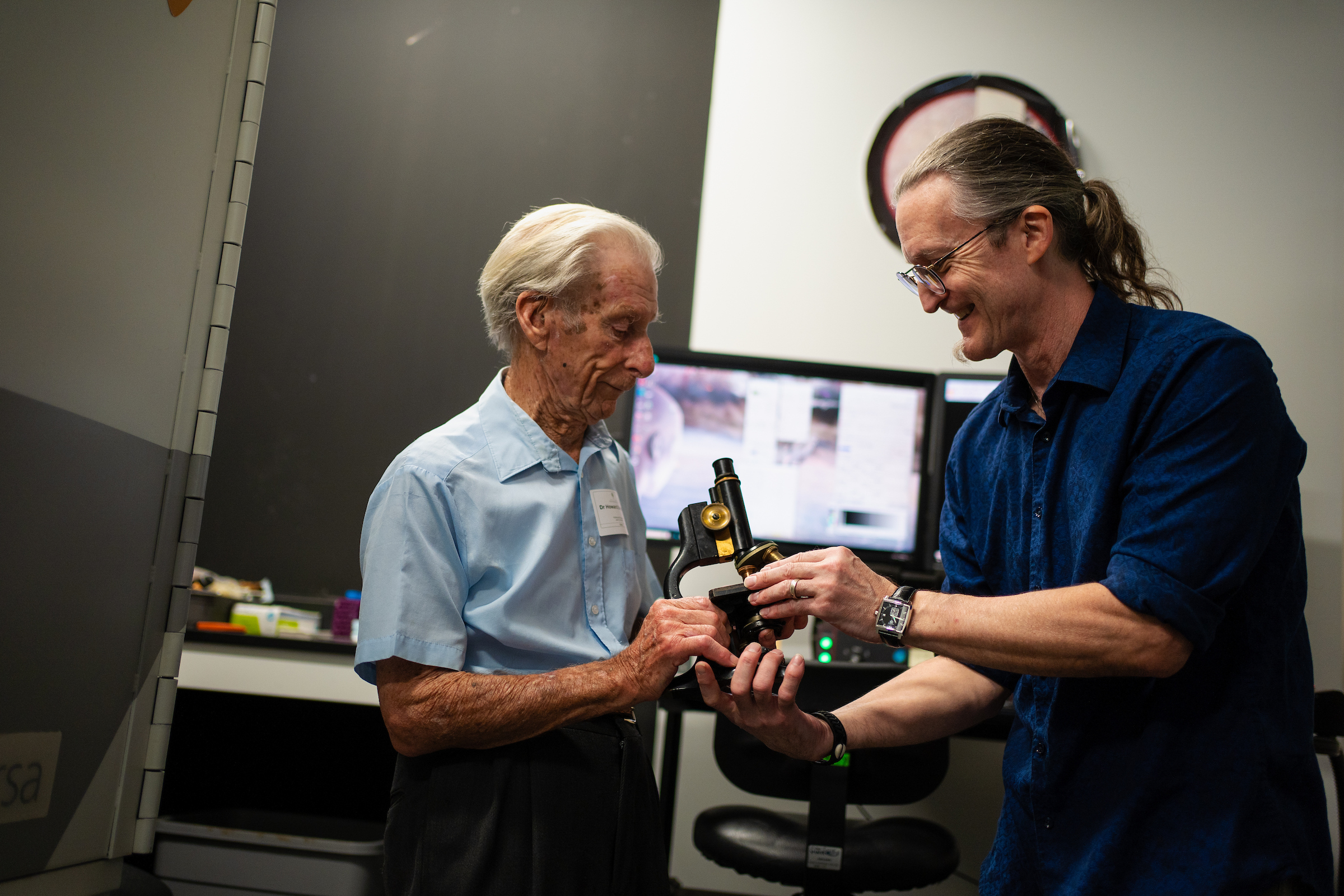
Keith and Howard looking at Howard’s old microscope from the early 1900s. The microscope, which Howard used in medical school, sparked in Keith a fascination with the natural world, and led him to his career in the sciences.
The Macro Level
At 97 years old, now it’s Howard that’s following in his son’s footsteps. At least once a year, he visits Keith at the Center to learn “where we are, where we are going, and what's new.” On his most recent trip, he reflected on the equipment he used back in his time, saying, “It took weeks to get numbers. But here, you’ve got enormous versatility and magnification, which is beyond what we ever thought of. So this is, shall we say, breathtaking.” At the heart of it all, along with their shared passion for science and discovery, Keith and Howard Duncan are driven by a desire to improve people’s lives, and that has led them both to support the Center financially. “The Center is doing unique things in the world that universities and private companies are not in a position to do,” Keith says. “It's difficult to think of anything more important in my world to support.”
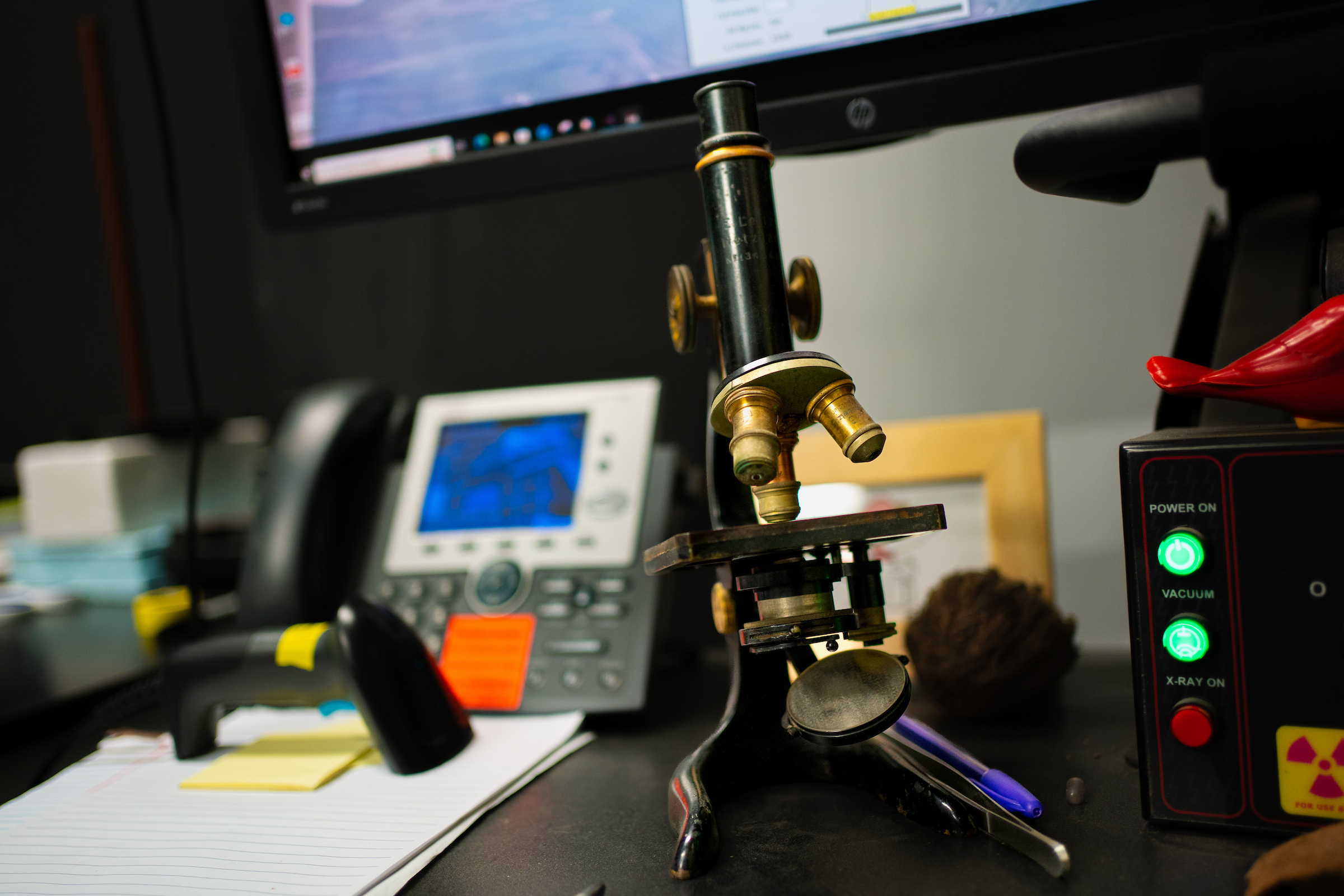
The antique microscope now sits on a desk next to the X-ray machine that Keith operates. He has dubbed the modern-day set up Cygnus X-1 after one of the brightest X-ray sources in the sky.
Share the Vision
As Keith says, the Danforth Center’s combination of expert plant scientists and cutting-edge technology is unique in the world and fosters critical work to feed the world and heal the planet. None of it would be possible without our supporters. By donating to the Danforth Center’s Future Forward campaign, you can help make more progress happen.