From Grapevine to Glass: the Plant Science of Terroir in Wine
Whether you’re a wine connoisseur, a total abstainer, or something in between, you’re probably familiar with the concept of wines that are specific to very particular places. Perhaps the most widely known example is champagne; while the term is often used interchangeably to describe any sparkling white wine, winemakers reserve the name champagne for wine made from grapes grown in the Champagne region of France. In fact, the place of origin is taken so seriously that a wine label is only legally allowed to read “champagne” if it meets that standard.
The reason for distinctions like this one is a concept called terroir, the idea that all the elements of a grapevine’s environment—the soil, the climate, the topography, even the weather in a given year—leave their mark on the final product and can have a significant effect on the taste of the wine that ends up in the bottle.
While some are skeptical about the difference in taste, terroir is essential to wine enthusiasts. And right now, one of the newest additions to the Danforth Center Field Research Site is a vineyard, where the Miller Lab is part of a nationwide effort to study the science behind terroir.
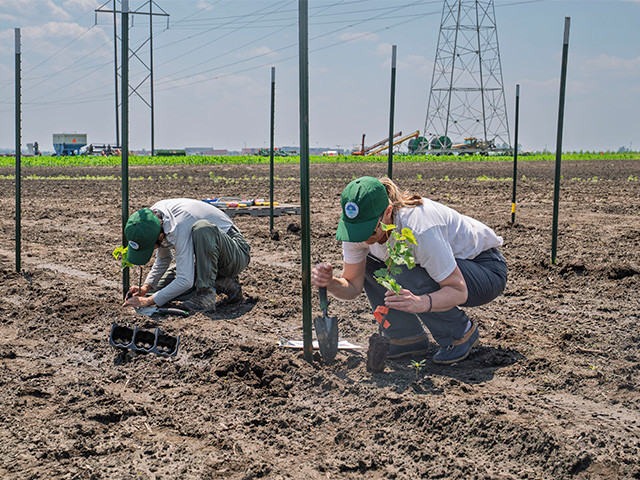
Allison Miller, PhD, and Miller Lab Technician Isabella Vergara plant grapevines at the Danforth Center Field Research Site, where they will study how a grapes’ growing environment shapes the flavor of wine.
The Science Behind Fine Wines
There are plenty of other factors beyond terroir that affect the character of the wine that ends up in your glass (like which grape cultivar is used, how the grapes are processed, etc.). But even when all other factors are consistent, a difference of growing location is known to impact the final flavor.
Interestingly, grapevines used in viticulture are often propagated clonally, meaning that the exact same genetic individual (think identical twins) can be planted over and over, all around the world. So how is it that two genetically identical grapevines grown in two different places can result in such different wines? And what is occurring on a molecular level to make that happen? This is what the Miller Lab’s National Science Foundation (NSF)-funded experiment has set out to learn.
For the experiment, the exact same grapevines were planted in four different locations in the United States: Geneva, New York; Brookings, South Dakota; and State College, Pennsylvania. Each of the four vineyards includes four different scions (the part of the grapevine that you see above ground), and each scion is grafted to four different rootstocks (the part of the grapevine that grows below ground) for a total of 16 combinations of scion and rootstock to be studied.
“We have a hypothesis that the vines—both in the scions and in the rootstocks—undergo epigenetic modification in response to the conditions of wherever it is that they are living,” Miller explained.
“Epigenetic modification can happen in different ways. The way that we are studying is when a methyl group attaches to the outside of the DNA—so the DNA sequence is not changing, but the way that the DNA is expressed is changed as an effect of the attachment of this epigenetic signal. This type of epigenetic modification, called methylation, changes how the vine works.
“We think this might be why when you plant genetically identical vines in different places that they produce a product that is so different.”
Scientists from the Miller Lab prepare grape roots for sampling. Pictured here are Saint Louis University PhD Candidate Nia Worth, Saint Louis University Undergraduate Researcher Julia Erker, and former Miller Lab Technician Isabella Vergara, who is now pursuing a PhD student at
Michigan State University.
To study how this process happens over time, the scientists took samples of all the grapevines before planting. Their genetic makeup before planting will be used as a baseline comparison over the course of the experiment as the grapevines grow and change.
“You can imagine all the questions!” Miller said. “Will all the vines here in St. Louis have the same epigenetic signature and all the vines in South Dakota have a completely different one of their own? Will the modification be specific to the scions, or will it also affect the rootstocks? If both are affected, will the signatures be different?”
The answers could give insight to the wine industry about what is happening on a molecular level—and answer some questions about just how significant the differences of terroir are.
Why Missouri? The Wider World of Wine Research
Miller says she is frequently asked why her team is studying grapevines in Missouri. For one thing, Missouri has a crucial role in viticulture history. When pests devastated European vineyards in the late 1800s, botanists and viticulturists had to work quickly to save the wine industry. After determining that American varieties were resistant to pests, they began to graft European varieties of grapes to American grapes’ rootstock to boost the resistance of the European varieties. The solution worked and ultimately spared European grapes from utter ruin as pests continued to spread in coming years. In fact, it was a plant nursery here in St. Louis, Missouri, that shipped some of the first vines for grafting across the ocean to vineyards in France. You can learn all about that history here.
To this day the global wine industry depends on grape rootstocks that are native to Missouri, the Midwest, and Texas. But there are practical reasons for studying grapes in Missouri even beyond the historical connection.
“We didn’t come to this experiment haphazardly. There was a lot of thought, dialogue, and communication among researchers to get here. We collaborate a lot with researchers in California to figure out what makes the most sense for each of us to study in the different habitats.”
For example, Saint Louis University PhD candidate Danielle Hopkins, who is in the Miller Lab, is currently conducting research on a vineyard in California through a graduate research fellowship she was awarded by the Foundation for Food and Agriculture Research (FFAR). Her research is investigating the genetic and physiological bases of water use efficiency. A better understanding of those processes could be crucial for future growers in times of drought, a familiar threat to Californian agriculture.
Why This Matters
Eventually, all the grapes produced by the vineyards in the NSF experiment will be made into wine, vine by vine. This will allow the scientists to identify patterns between the epigenetic signatures they are tracking and their effect on the product that so many people care about.
“In the wine industry, you can imagine that growers might reference this kind of information to optimize their vineyard. For example, if there are vines that have become accustomed to a particular place that have changed epigenetically in response to their surroundings, you can see that they might want to preferentially plant those vines.”
And even beyond the world of agriculture, its findings will likely provide some fascinating insights for biology.
“It is inherently interesting that long-lived, clonally propagated organisms take on a signature of their environment, and it changes what they look like and how they behave. That is a cool question for science in general,” she said.
This collaborative experiment is the only study of its kind in the world right now. It will take a few years to gather and analyze the data, but the outcome could hold some fascinating, industry-changing information. And, as all those who enjoy a good glass of wine know, the best things take time.