Danforth Center Scientists Unlock the Hidden Metabolism of Algae — Advancing the Promise of Renewable Fuels and Sustainable Biomass
New PNAS study maps how green algae rewire their metabolism to grow faster, giving scientists a long-sought roadmap for engineering algae-based bioproducts without competing for farmland
ST. LOUIS (April 2, 2026) — Researchers at the Donald Danforth Plant Science Center have solved a long-standing mystery of how a model green microalga reorganizes its central metabolism to super-charge growth when given access to both light and a carbon source — a finding with broad implications for developing algae as a sustainable source of renewable fuels, bioproducts, and biomass. The study was published in Proceedings of the National Academy of Sciences (PNAS).
Algae are among Earth's most productive life forms. Along with other photosynthetic microbes, they capture roughly half of all carbon absorbed from the atmosphere globally each year. Unlike land crops, algae can grow on land unsuitable for food production and generate oil, protein, and other valuable compounds at rates 10 to 50 times greater than most terrestrial plants. Yet translating that productivity into reliable, scalable bioproduct yields has proven difficult — largely because the metabolism governing how algae partition carbon under different growth conditions was poorly understood.
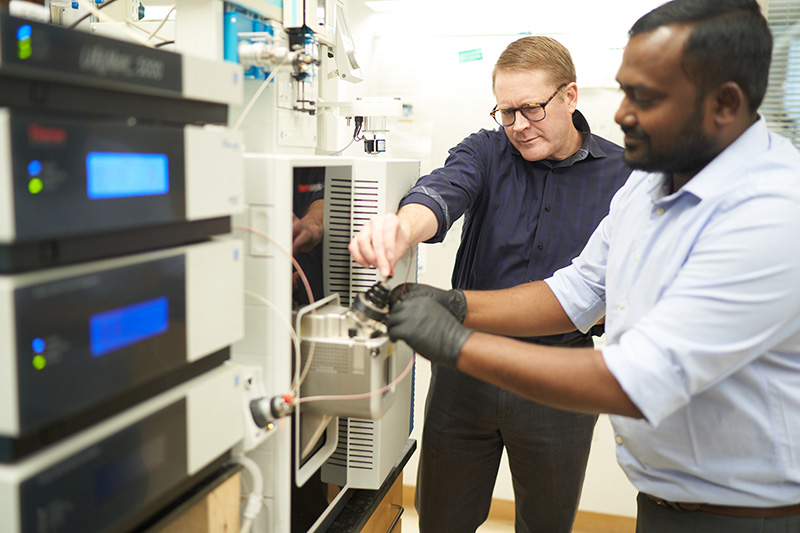
Danforth Center Principal Investigator Dr. Doug Allen (left) and Dr. Somnath Koley in the Danforth Center Bioanalytical Chemistry Facility.
Using isotope-assisted metabolic flux analysis (MFA) — a technique that measures how carbon moves through cellular pathways— the research team led by Somnath Koley, previously in the Allen lab at the Danforth Center, compared algae grown on light alone versus algae grown on both light and acetate, a condition known as mixotrophic growth. Rather than simply combining the two energy sources, the cells were found to fundamentally rewire their metabolism: activating highly efficient biochemical pathways to conserve carbon, suppressing a separate carbon-costly process, and strategically reducing photosynthesis in ways that lower the burden of protein production and enable faster growth (which greatly surpasses the additive effect of light-only growth plus acetate-only growth) — a result that prior computational models had failed to predict.
"What metabolic flux analysis reveals is the actual operating strategy of the cell — not a snapshot of gene or protein levels from -omics data, but the real rates at which carbon is moving through each pathway," said Doug K. Allen, PhD, principal investigator at the Danforth Center and one of the corresponding authors. "Those real-world flux constraints are what you have to work with if you want to rationally engineer algae for higher yields."
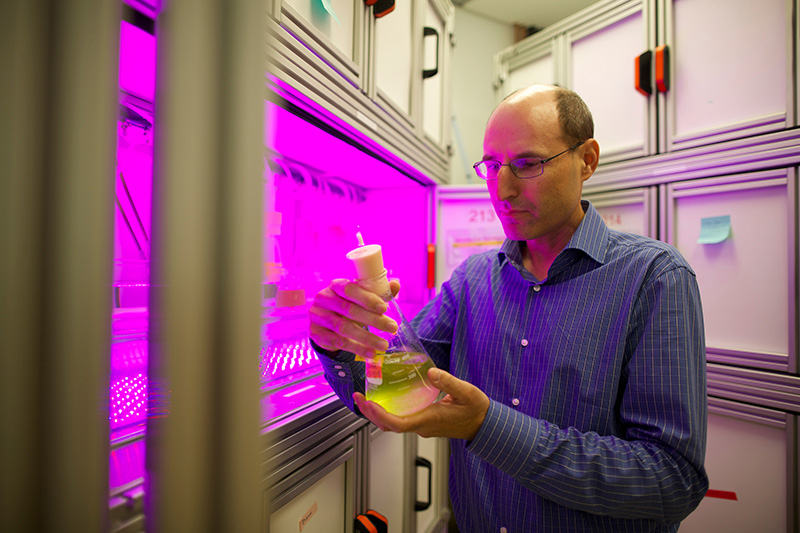
Danforth Center Principal Investigator Dr. James Umen with a flask of algae.
"Without flux analysis, we couldn't have resolved the long-standing paradox of how acetate affects algae growth,” said James G. Umen, PhD, principal investigator at the Danforth Center and another corresponding author. “This study shows that metabolism is fundamentally different — and far more efficient — when light and acetate are both present, and that insight is critical for anyone trying to engineer algae for higher productivity."
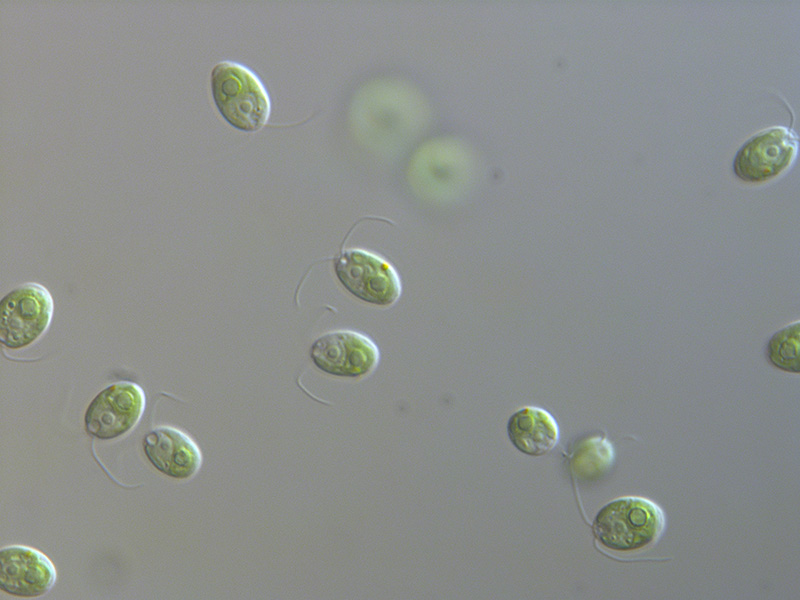
Chlamydomonas algae used in the research.
The Danforth Center was founded with an urgent sense of purpose: to move plant science out of the laboratory and into the hands of partners, farmers, and communities who need it most.
"At the Danforth Center, we measure success by impact — in the field, in the agtech innovation sector, and in the communities building a more sustainable future," said Giles Oldroyd, PhD, President of the Danforth Center. "Doug and Jim's teams have provided something rare and valuable: a quantitative map of how algae actually manage carbon. That's the kind of foundational insight that accelerates the path from discovery to real-world solutions — whether that's a more sustainable fuel, a new biomass crop, or a bioproduct that reduces our dependence on fossil fuels."
Citation
Koley, S., Foley, K., Perrine, Z., et al. (2026). Metabolic rewiring and biomass redistribution enable optimized mixotrophic growth in Chlamydomonas. PNAS, 123(4), e2522572123. https://doi.org/10.1073/pnas.2522572123
About the Danforth Center
Founded in 1998, the Donald Danforth Plant Science Center is the largest independent nonprofit dedicated to plant science in the world. With a mission to improve the human condition through plant science, the Center conducts plant science research to feed people and improve human health, preserve and renew the environment, and innovate for economic development in the US and around the world. For more information, visit danforthcenter.org
Media Contact: Kristina DeYong | Public Information Officer, Danforth Center | kdeyong@danforthcenter.org