From a Greek Oat Field to the Sparks Lab: Fulbright Scholar Anna Siosiou Spotted a Trait in Oats that Could Help Protect Yields in a Changing Climate
When Anna Siosiou looked closely at an oat variety in her home lab in Greece, she noticed something no one expected: a ring of roots was growing from the stem above the soil line. Corn has these roots, called brace roots, and so do sorghum and some other grasses. In oats, no one had documented them.
"We'd never seen them in oat until Anna observed them," said Erin Sparks, PhD, a principal investigator at the Donald Danforth Plant Science Center and the University of Missouri's Bond Life Sciences Center. Siosiou is spending six months in the Sparks lab as a Fulbright visiting scholar.
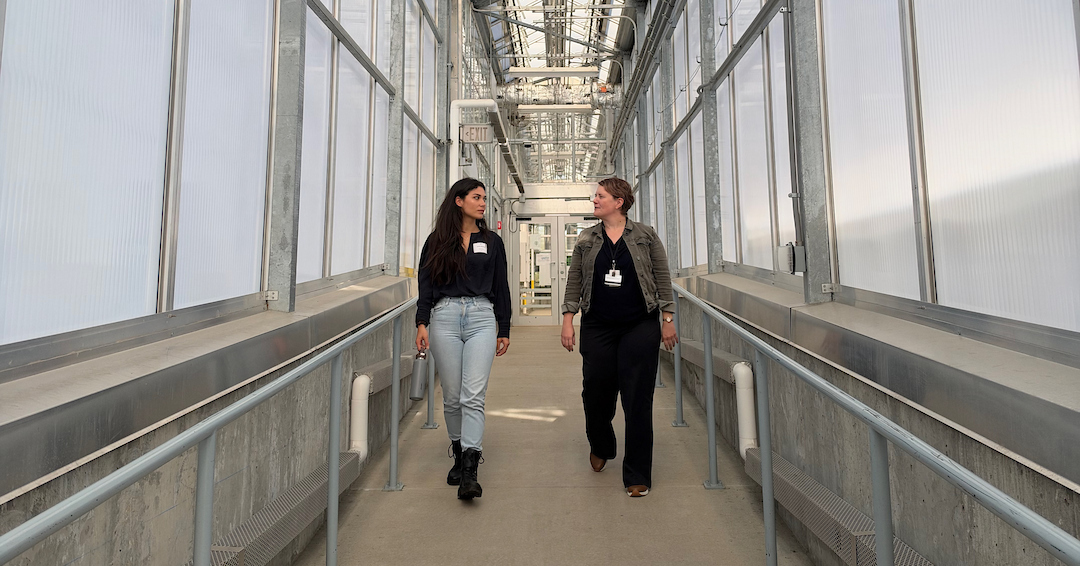
Fulbright visiting scholar Anna Siosiou (left) and Erin Sparks, PhD, discuss Siosiou’s research while walking through the Danforth Center’s greenhouse facilities.
Brace roots are the core of Sparks' research, which she began at the University of Delaware. Trained as an engineer, she studies how the roots hold a plant up under force, and her lab builds its own tools for the work. One is a shoebox-sized device called the SMURF, short for Sorghum and Maize Under Rotational Force, which pushes on a plant the way a strong wind would measure how springy its roots are. (See a video of the SMURF in action here.)
Siosiou is a PhD candidate in agroecophysiology at the Aristotle University of Thessaloniki. The oat that started it all now carries her name: Avena sativa 'Anna'. Her advisor, Dr. Ioannis Tsialtas selected the line from plants growing among other cultivars and kept the ones that stayed upright. He named it after Siosiou, who is now contributing to the description of the variety paperwork.
The roots weren't the goal of the selection. Tsialtas and Siosiou spotted them by chance. Siosiou then remembered a 2021 paper from the Sparks lab that suggested brace roots might be more widespread than anyone knew. She reached out to Sparks, and the two began planning how they would validate the trait after publishing a first report.
"When she applied for the Fulbright, Anna told me, 'I'm not going to get this, but if I did, would you host me?'" Sparks recalled. "And then she got it. It's super competitive and really prestigious, so we're very excited to have her."
Why No One Noticed
Brace roots are hard to miss on towering corn, where they jut out visibly from a bare stalk. On a grassier plant like oat, they are easy to overlook. Timing matters too. In corn, the roots appear early in the season. In oat, they don't emerge until the plant starts to flower. Oats grown for livestock feed are often cut before then.
Siosiou and Sparks have since seen similar roots in other cereals, including wheat. "We think these roots are more common, but people just aren't looking," Sparks said.
Part of the reason is that brace roots fall between disciplines. Sparks has noted that root researchers don’t treat them as roots because they grow above ground, while shoot researchers consider them roots. Part of it is history: for decades, crop improvement has focused on yield above almost everything else. "It just goes to show the focus on yield has been so paramount that it dominated everything," Sparks said.
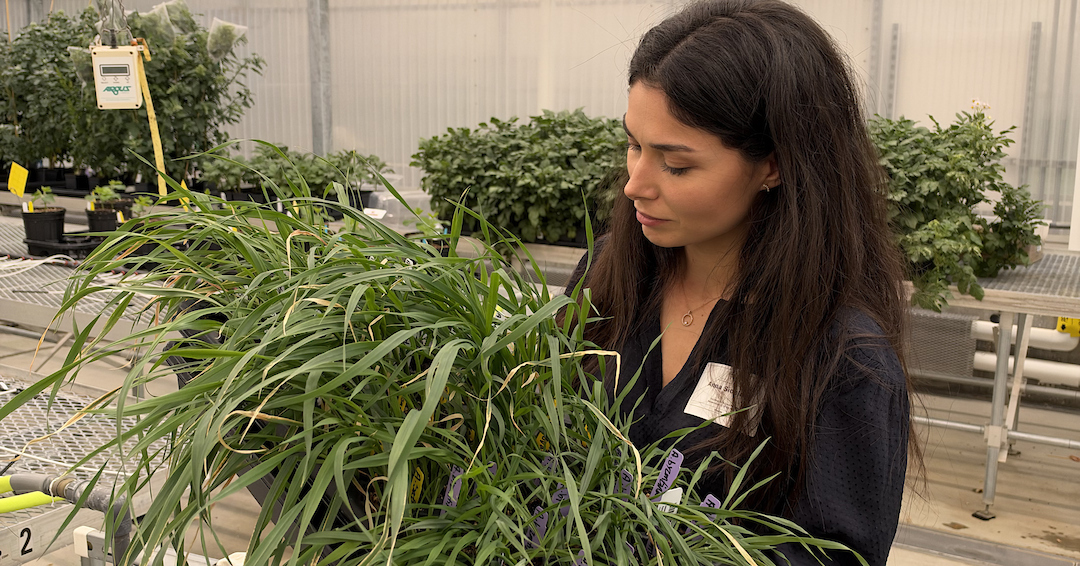
Siosiou examines plants during her six-month research visit to the Sparks Lab.
A Trait for a Changing Climate
The questions now are whether oats use the same genes and pathways as corn to make these roots, and whether the roots help plants stay upright. When crops fall over, a problem called lodging, farmers lose part of the harvest.
"The baseline is that it's a botanical trait that we never looked into," Siosiou said. "In Greece right now, with climate change, we have huge events of heavy rain and wind."
If brace roots do improve stability, they could become a new target for oat breeders. Sparks noted that brace roots have never been a deliberate breeding target even in corn—and her corn research shows how much roots matter. In a study with Bayer Crop Science published this year in Crop Science, short-stature corn hybrids had wind damage at less than half the rate of conventional hybrids, and her team found that some of the shorter lines had root systems 30% more flexible than taller ones.
"In corn, we've seen that what's happening at the base of the plant can decide whether a field is still standing after a storm," Sparks said. "If brace roots are helping oats stay upright, that's a trait breeders could select for, and it will matter more every year as storms get stronger."
'Anna' has other traits that interest Siosiou. Its flowering time makes it a good partner for legumes like common vetch in intercropping systems. In Greece, farmers mostly grow oats for fodder and cut and roll them for storage.
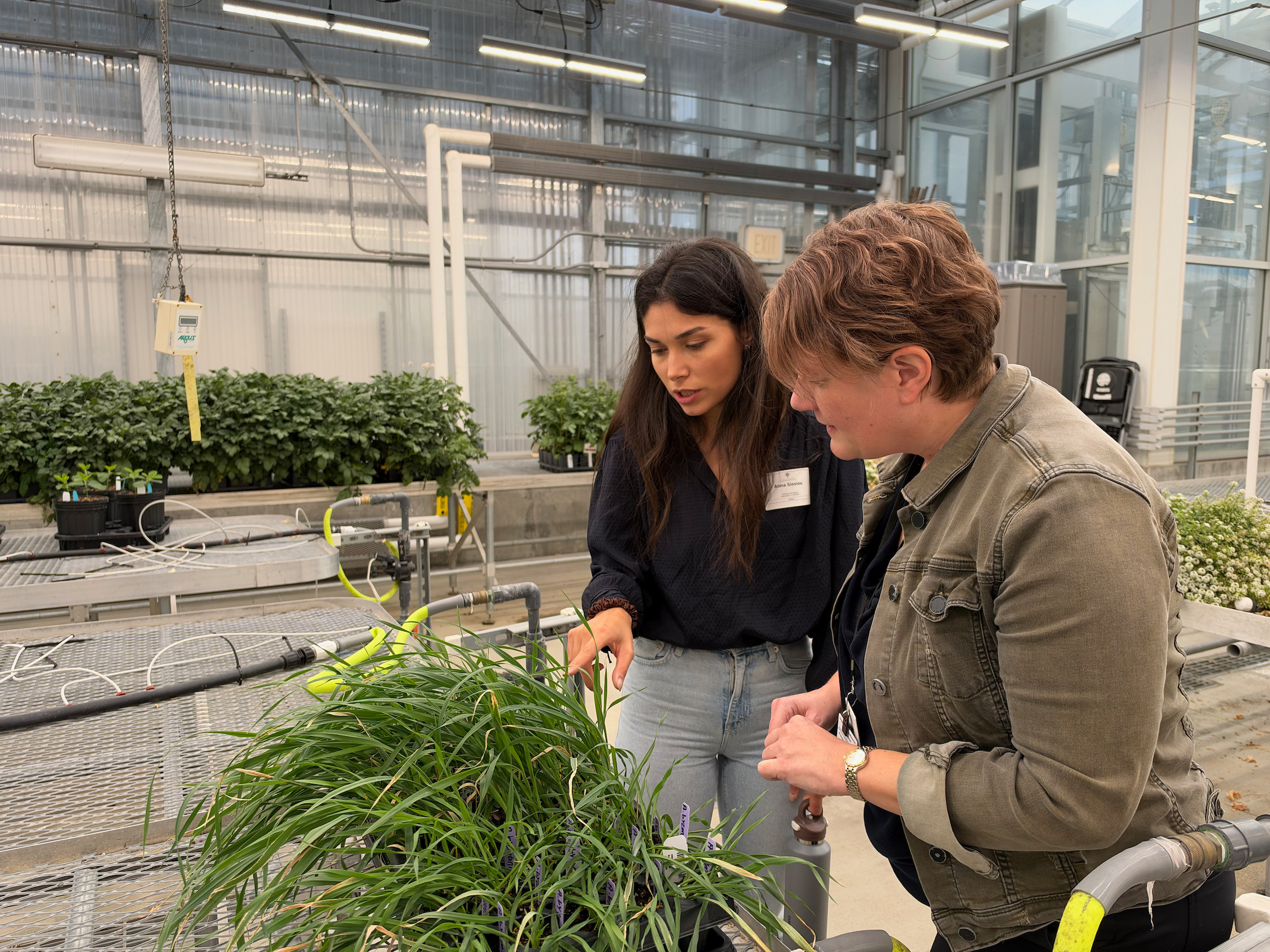
Siosiou shows Sparks where brace roots will emerge from an oat stem above the soil line.
Why It Matters
Siosiou’s visit is the kind of exchange the Fulbright Program was built for. The program’s stated mission is to foster mutual understanding between nations, advance knowledge across communities, and improve lives around the world. A question that began in a Greek oat field is now being tested with tools developed for corn in Missouri. And the findings could benefit farmers growing grains around the globe.
“Farmers everywhere are dealing with heavier storms, and when a field blows over, the water, fertilizer, labor, and profits are lost,” said Dmitri A. Nusinow, PhD, director of research for sustainability at the Danforth Center. “Traits that keep crops standing help farmers get more from every acre and feed the world sustainably.”