Agrela Ecosystems Expands Nationally as PheNode Platform Moves from Agricultural Research into Transportation Infrastructure
St. Louis Agtech company spun out from the Danforth Center builds customer base across university research, specialty crops, and state highway systems
ST. LOUIS (May 21, 2026) — Agrela Ecosystems, the St. Louis-based environmental sensor company behind the PheNode® platform, is expanding its national sales presence as demand for its field-deployable monitoring technology grows beyond agricultural research into transportation infrastructure and specialty crop production. The company closed a $500,000 funding round in February 2026, led by QRM Capital and the St. Louis Port Authority, to support that growth.
Founded in 2016 by plant scientists at the Donald Danforth Plant Science Center, Agrela launched PheNode commercially in 2023, generating more than $500,000 in sales since commercialization. The platform is a scalable, modular environmental sensor system that collects real-time data on air temperature, humidity, rainfall, wind, light, soil conditions, and more, giving users continuous, research-grade insight into environmental conditions across large areas.
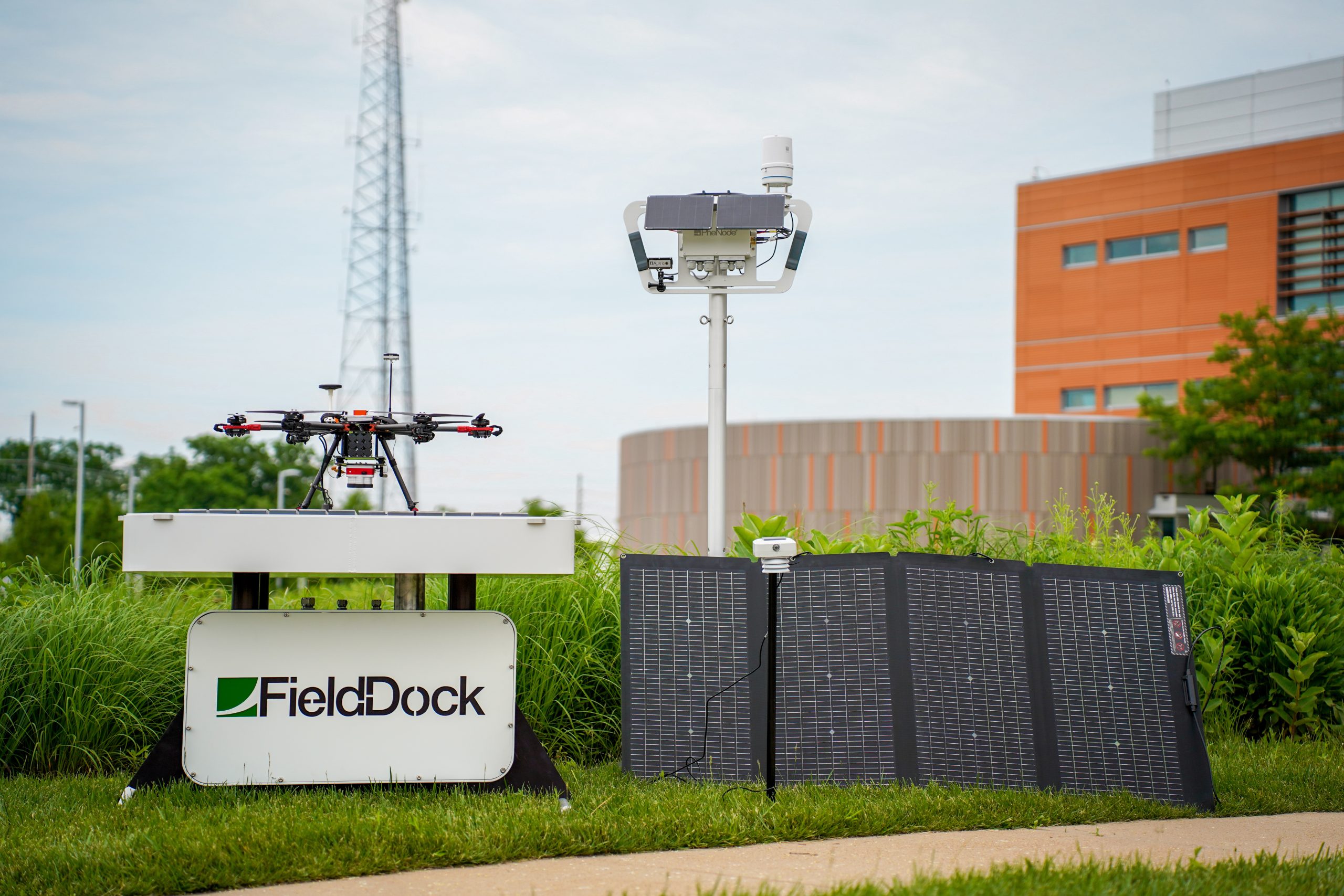
The PheNode® environmental sensor platform, developed by St. Louis-based Agrela Ecosystems, deployed alongside the FieldDock drone station at the Donald Danforth Plant Science Center.
PheNode's expansion into transportation infrastructure marks one of the more unexpected chapters in the company's growth. The platform has become an integral part of The Ray, a nonprofit dedicated to sustainable highway infrastructure, which has deployed PheNode to monitor vegetation, soil, and air quality along interstate highway rights-of-way. What began as a first-of-its-kind pilot along an 18-mile stretch of Interstate 85 in West Georgia, in partnership with the Georgia Department of Transportation, has since expanded to Washington state in partnership with the Washington State Department of Transportation, establishing The Ray and PheNode as a replicable national model for data-driven highway greenspace management.
“PheNode was designed to fill a gap that we felt every day as researchers: the need for flexible, accurate, field-deployable environmental data that doesn't require a full laboratory to interpret," said Nadia Shakoor, PhD, Danforth Center principal investigator and co-founder and CSO of Agrela Ecosystems. “This investment reflects growing recognition that the need for that kind of data extends well beyond agriculture.”
Dr. Shakoor's path from researcher to entrepreneur reflects the Danforth Center's approach to impact. A Center scientist since 2014, she has led major initiatives advancing crop genomics and field phenotyping: work that identified a critical gap in the availability of flexible, research-grade environmental sensing tools. She recently received the inaugural Innovator Award from the Academy of Science–St. Louis, which honors those who translate scientific discoveries into practical applications with meaningful societal impact.
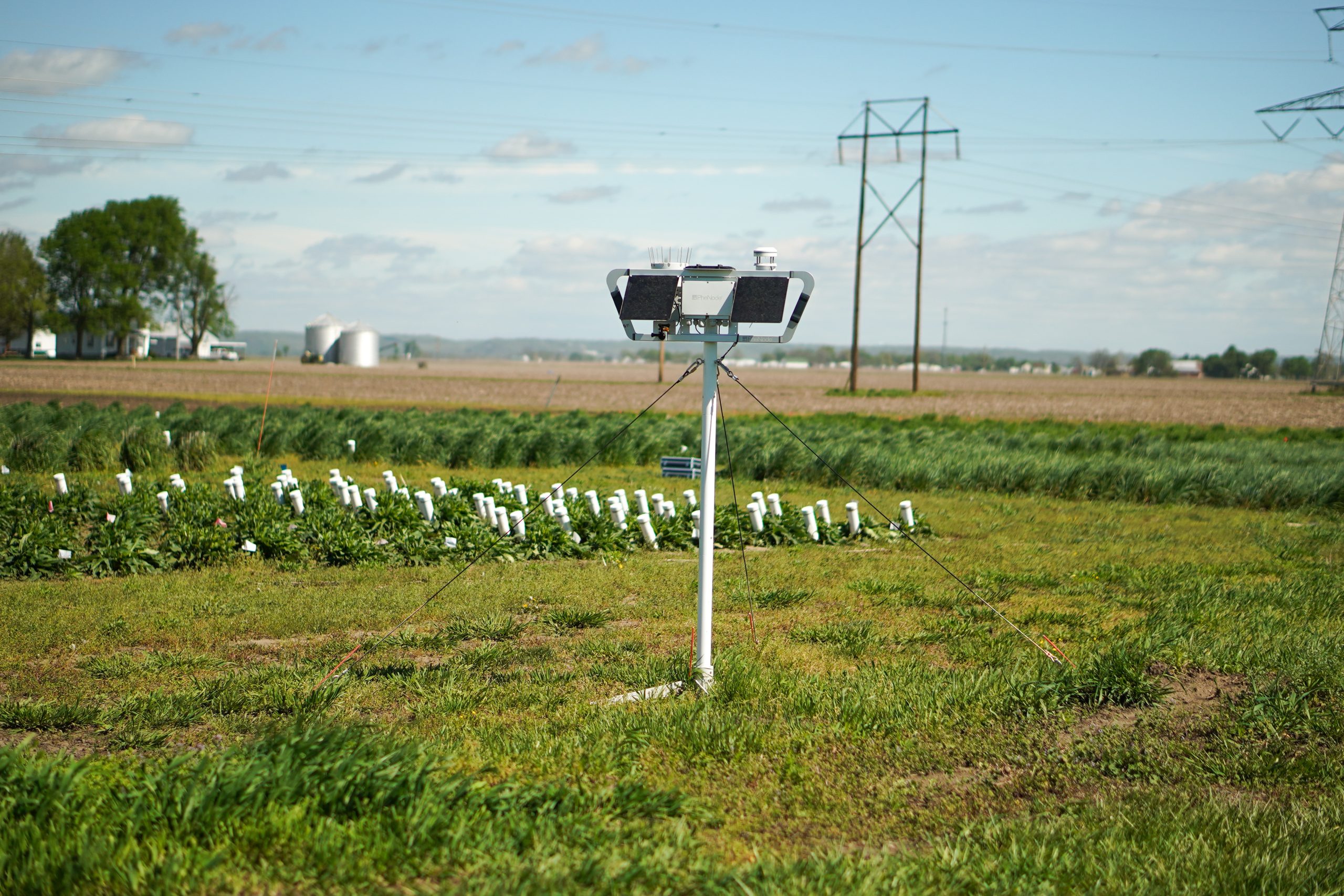
The PheNode® environmental sensor platform deployed in a specialty crop research field, where it monitors soil, weather, and air conditions in real time.
Bill Kezele, Agrela's president and CEO, said the February funding round positions the company to meet demand that has outpaced its current capacity. "We have been deliberate about building the right product before scaling the business," Kezele said. "This round gives us the resources to further develop our local, St. Louis-based manufacturing pipeline and scale the company efficiently."
Agrela's growth reflects the kind of lab-to-market translation the Danforth Center and the broader 39 North agtech ecosystem are built to accelerate—from foundational research, to field-ready technology, to national commercial scale.
“One of the most exciting things about research at the frontier is that you rarely know in advance where it will lead,” said Giles Oldroyd, PhD, Danforth Center president. “The PheNode was built to serve plant scientists. The fact that it is now helping naturalize highway corridors across the country is exactly the kind of unexpected outcome that reminds us why foundational research matters—and why we invest in people like Nadia who are willing to follow the science wherever it goes.”
About Agrela Ecosytems
Founded in 2016 by plant scientists at the Donald Danforth Plant Science Center in St. Louis, MO, Agrela Ecosystems delivers scalable, flexible environmental monitoring through its flagship product, PheNode®. Designed for agricultural research, specialty crop production, and smart infrastructure, PheNode combines high-resolution sensing, wireless scalability, and cloud-based data visualization to support data-driven decision-making across industries. Learn more at agrelaeco.com.
About the Danforth Center
Founded in 1998, the Donald Danforth Plant Science Center is the largest independent nonprofit dedicated to plant science in the world. With a mission to improve the human condition through plant science, the Center conducts plant science research to feed people and improve human health, preserve and renew the environment, and enhance our region as a world center for plant science. For more information, visit danforthcenter.org
Media Contact:
- Bill Kezele, Agrela Ecosystems bill@phenode.com
- Kristina DeYong, Danforth Center kdeyong@danforthcenter.org